Why Cricket Fielding Positions Move Before and During a Delivery
Cricket fielding positions shift to invite shots, prevent runs, or create chances; learn how to read each move and distinguish a planned change from a reaction.
The most common mistake when reading cricket fielding positions is to treat each spot as permanent, then assume any movement means the captain has corrected an error. That can make a deliberate adjustment look random. A field is a plan for a particular delivery or passage of play, shaped by the bowler’s target, the batter’s options, and the match situation.
Position names such as slip, cover, and fine leg describe areas relative to the batter and pitch, not painted marks on the grass. To understand a move, ask what the bowler is trying to make difficult, where the batter is likely to hit, and what the team has chosen to protect.
Why do cricket fielding positions change before a ball?
A captain may change the field between deliveries because the next ball is meant to ask a different question. The bowler might change line, length, or pace, or the captain may want to respond to a batter’s recent shot. The same batter could be strong through cover but less comfortable with a ball directed toward the body, so the field can invite one stroke while guarding against another.
Fielders may also adjust during a delivery in response to the ball and the batter’s shot. That is different from a planned repositioning. The exact timing and movement permitted depend on the Laws of Cricket and the competition’s playing conditions; some conditions also impose restrictions on where fielders may stand or move. For a particular match, those conditions govern. As a viewer, distinguish the settled field before the delivery from movement that reacts to the play.
Watch the field and bowler’s target before the batter faces. A change is easier to interpret as preparation for the next delivery than as a correction to the previous one.
What does a fielding-position name tell you?
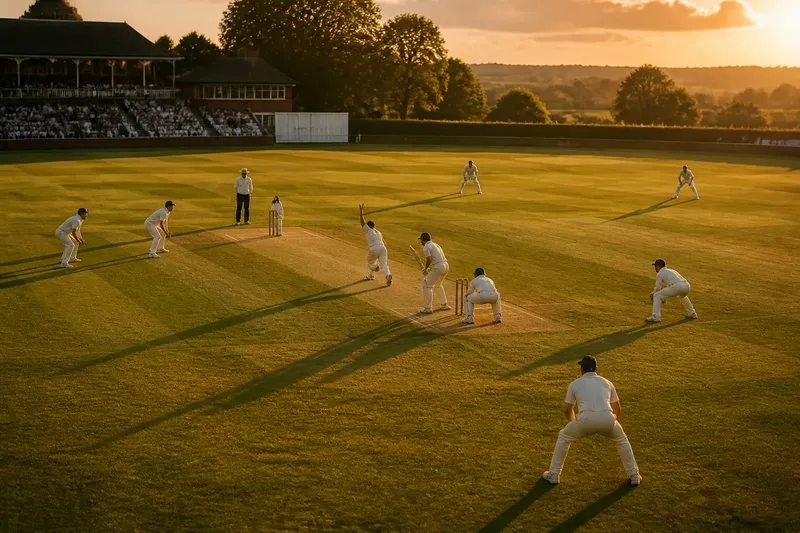
Position names offer a map, not an exact placement. A slip fielder stands behind the batter on the off side, ready for an edge. Cover is farther around the off side, where a fielder can stop or intercept a drive. Midwicket is on the leg side, while fine leg is behind the batter on that side. The precise angle and depth can vary.
Two descriptions help explain distance from the batter. A close catcher stands near enough to take a sharp chance, while a boundary fielder is deep, positioned to stop a hit reaching the rope or attempt a catch. A captain might set a deep cover rather than a close one, depending on the batter’s stroke and the bowler’s plan.
Find the broad zone first. The position name gives you a clue about the shot or chance the team has in mind, even when the fielder is not standing where a diagram places them.
Why leave a likely scoring shot open?
A field cannot cover every part of the ground at once. If the captain places more fielders on the leg side, another area may have fewer defenders. The gap may be intentional: the bowler can encourage a shot toward a protected side, or the captain may accept a boundary risk to create a catching chance elsewhere.
An attacking field can place close catchers where a mistimed shot might carry. A more defensive field can put players near the boundary to stop a well-struck ball reaching it. Neither arrangement is automatically right. The choice depends on the bowler’s control, the batter’s habits, the fielding restrictions that apply, and whether the team values a wicket or run prevention more in that situation.
Say a batter has driven firmly through cover, and the bowler plans to bowl outside off stump. Imagine the captain moves a fielder from a catching position to deep cover. The visible result would be a defender near the boundary on that side, while the batter still has the option to drive. The tradeoff is less catching pressure close to the bat in exchange for protection against a familiar scoring stroke.
Why can’t the captain cover every likely shot?
Cricket rules and playing conditions limit how a field can be set, and the details can differ by format and circumstance. The captain also has a finite number of fielders, while the bowler and wicketkeeper have essential roles. Even within the permitted arrangement, protecting one area leaves another less covered.
A field is a set of priorities, not a complete shield. A captain might protect a boundary, keep a catcher near the bat, or bring a fielder in to stop easy singles. Each choice addresses a different risk. A fielder inside the ring may cut off a quick run but be unable to reach a shot that passes them.
When a fielding restriction applies, the umpire’s signals and the match format can help explain why a captain cannot place another player wherever they choose. Consult the competition’s playing conditions or the governing body’s guidance if a specific restriction matters.
What should you check when a fielder moves?
Use a move as a clue, then see whether the next delivery supports your reading. Check the batter’s recent shots, the bowler’s line and length, and whether the moved fielder is close in or deep. Then watch whether the batter plays into that area and whether the fielder stops a run, limits a boundary, or creates a catching chance.
- Check which side the fielder covers. Off side and leg side are defined from the batter’s viewpoint. If the move strengthens the side where the batter has been scoring, expect a plan to limit that stroke; if it leaves that side open, consider whether the bowler is inviting the shot.
- Check the fielder’s distance. If a player moves from the ring toward the boundary, watch for protection against a powerful hit; if a player moves closer, watch for a blocked single or a catching chance, while allowing for a larger gap behind them.
- Check the bowler’s likely target. If several fielders are set on the off side, watch whether the bowler attacks that channel; if the bowler targets the leg side instead, reconsider what the arrangement is protecting.
- Check the match situation. If the field appears set to prevent easy runs, watch for a defensive priority; if close catchers are added, watch for a greater emphasis on chances, while remembering that the format and playing conditions shape the options.
- Compare more than one delivery. If the same area remains protected across several balls, treat it as a continuing plan; if the field changes again, consider whether the captain is responding to a new shot or delivery.
- Check whether a restriction applies. If the umpire signals a fielding restriction or the competition conditions specify one, account for it before judging the placement; if no relevant restriction applies, focus on the captain’s tactical choices.
Keep your reading small: one move, one possible purpose, and one result to watch.
Which questions about cricket fielding positions come up most often?
Can a fielder move after the bowler starts the run-up?
The field’s permitted arrangement and the timing of movement are governed by the Laws of Cricket and the match’s playing conditions. Fielders can react to the ball and the batter’s shot, but planned changes and restrictions should be assessed under the applicable rules rather than treated as unrestricted movement.
Why does the same position look different at another ground?
A position name describes a zone relative to the batter and pitch, not a fixed mark on the grass. The ground’s shape and the captain’s chosen angle or depth can make a fielder look differently placed while serving the same broad role.
Why bring a fielder closer to the batter?
A closer fielder may stop a quick single or take a mistimed shot, especially when the bowler is trying to build pressure. The tradeoff is that a firmly struck ball may pass the fielder into a less protected area.
Does every move mean the bowler has changed the plan?
No. A captain may respond to the batter’s recent shot, the match situation, or a desired fielding position while the bowler’s intended delivery remains similar. Watch the next ball before deciding what the adjustment was intended to do.
How can you read a field without memorizing every name?
Start with three questions: what shot is the bowler inviting, what area is the captain protecting, and what chance is the field trying to create? Use familiar anchors such as slip, cover, midwicket, and fine leg, then describe other fielders by their side and distance. You do not need to identify every position to follow the tactic.
Imagine you are watching a right-handed batter who has just driven through cover, and the captain moves a close fielder to deep cover before the next delivery. First, note the move from a catching position to a boundary position. Next, check whether the bowler targets outside off stump and whether the batter drives again. If the deep fielder stops the shot near the rope, the move has reduced the boundary threat but sacrificed a close catching option; if the bowler changes line or the batter plays elsewhere, the field’s intended tradeoff remains a clue, not proof of the plan.
Cricket fielding positions are easiest to read as answers to specific problems, not as a standard formation. Keep the main search phrase, cricket fielding positions, tied to a practical question: what did the captain move, what delivery followed, and what area did the change leave less protected?