From Scorebook to Scoreboard: Cricket’s Changing Record
Cricket scorebooks preserve the match ball by ball, while scoreboards make its changing state visible. Learn what each record captures and why it matters.
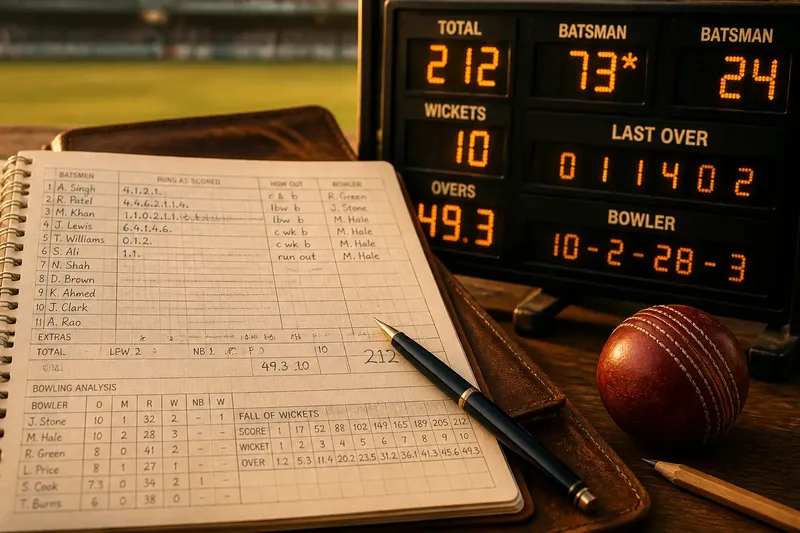
The most common mistake when reading cricket’s record is to treat the scoreboard as the complete account; that can hide how a total was built and which details may need checking. A cricket scorebook records the match in sequence, while the scoreboard presents a selected view of its current state. The two records serve different purposes, even when their numbers agree.
That distinction matters to a curious reader because a score is not merely a running total. It is also a record of who scored, how deliveries ended, which bowlers were involved, and when the innings changed. These compact field notes explain what a scorebook preserves, what a scoreboard makes easy to see, and how the two fit together.
What does a scorebook preserve that a scoreboard cannot?
A traditional scorebook is a working record, often kept on paper, that follows events in order. Its entries can show runs credited to each batter, runs charged to a bowler, extras, dismissals, and the progress of an innings. A printed scorecard may later condense some of that information, but the scorer’s record is where many details are first organized.
The sequence is its particular strength. A total of runs tells you how many were made, but not by itself how the innings moved. The ball-by-ball record can distinguish a quiet spell from a burst of boundaries, show when a wicket fell, and preserve the order in which batters came in. That context helps explain a score rather than simply state it.
Scoring also involves classification. A delivery that produces runs may be recorded differently depending on whether the runs came from the bat or were extras. A dismissal has a type, and not every dismissal is credited as a wicket to the bowler. Those distinctions affect individual figures and the interpretation of the innings.
A scorebook is therefore not just a ledger of arithmetic. It is a structured account of cricket events, created according to scoring conventions. It can support later summaries, but it is useful in its own right when a reader wants to understand how the figures arose.
Why does the scoreboard show less—and help more?
A scoreboard is designed for quick reading from a distance or at a glance. Its main job is to present the match’s current state: the team’s total, wickets lost, overs completed, the batters at the crease, and often the bowlers’ current figures. A venue may also display the target in a limited-overs chase or the result after play ends.
That display is selective by design. A screen has limited space, and spectators need prominent figures rather than every event in the innings. The current total and wickets may be large, while a recent over, batter’s score, or bowling analysis appears in a smaller panel or rotates out of view. The interface makes some facts easy to notice and others harder to retrieve.
In cricket, the scoreboard is also a shared reference point. Players, officials, and spectators can orient themselves around a common display without consulting the full scoring record. But a display can lag behind the action, omit a detail, or show a figure that is being updated. For a disputed or subtle detail, the fuller record and the officials’ decisions matter more than a glance at a screen.
Think of the scoreboard as a live summary, not a substitute for the scorebook. It answers “where are we now?” more readily than “how did we get here?”
How did cricket move from written books to electronic displays?
Before electronic displays became familiar, grounds used physical boards that attendants updated by hand. Depending on the ground, letters, numbers, or movable markers represented the score and other match details. A spectator might see the total and wickets clearly while needing a printed card or a scorer’s book for finer information.
Hand-operated boards made the act of updating visible. An attendant changed the display as the match progressed, translating the scorer’s record into a format the crowd could read. The board did not necessarily contain every item in the book; it offered a practical selection for the venue and the audience.
Electronic screens expanded what a venue could present. A display can switch between a live score, player figures, a recent sequence of deliveries, or a replay, and it can refresh without physically changing separate markers. At the same time, the underlying task remains: events must be recorded and classified before a system can present them reliably.
Digital tools have also made cricket scores available beyond the ground. A reader following a match on a phone may see a compact interface that resembles a small scoreboard, with a fuller scorecard available behind it. The channel has changed, but the editorial choice remains: show the urgent state first, then let the reader inspect details as needed.
What should a reader compare in the two records?
When the scoreboard and scorebook seem to differ, begin by asking whether they are showing the same moment and the same kind of figure. A live screen may update after a delivery, while a scorecard may still be refreshing. One view may show a batter’s runs; another may show the team total, which includes extras.
- Team total: Compare the runs and wickets, then check whether a new delivery or innings event has just occurred.
- Batter’s score: Confirm whose figures are shown and whether the display lists the striker, non-striker, or both.
- Overs: Read the notation as completed overs and balls in the current over, rather than as a decimal fraction of an over.
- Extras: Look for byes, leg byes, wides, and no-balls in the fuller record when the batter’s runs do not explain the team total.
- Dismissals: Check the dismissal description and whether the bowler receives credit, rather than assuming every wicket counts in a bowler’s figures.
- Bowling figures: Distinguish runs conceded and wickets credited from the team’s overall total, which can include runs not charged to the bowler.
Say you are following a match on a small phone screen and the team total rises by a run, but neither batter’s score changes. The display might be reflecting an extra rather than a run credited from the bat. Opening the full scorecard should make the distinction visible, while the live total tells you the team’s updated position.
This is a useful habit for any apparent mismatch: identify the figure, identify the moment, then inspect the category that could explain the difference.
Which details do readers often search for?
Does the scoreboard record every ball?
Usually, the main scoreboard presents a summary rather than a complete sequence. Some electronic displays include recent deliveries, but the fuller ball-by-ball account is typically found in a scorecard or live scoring feed.
Why can a team total differ from the batters’ runs?
Extras contribute to the team total without being credited as runs to a batter. Byes, leg byes, wides, and no-balls are recorded under their own categories, with the exact scoring treatment depending on the event.
Is the person operating the scoreboard the official scorer?
Not necessarily. A venue attendant or display system may show information supplied by the scoring operation, but the visible board and the official scoring record are distinct functions.
Where can I find the detail omitted from a ground display?
Look for a full scorecard or ball-by-ball commentary, which may include partnerships, fall of wickets, individual figures, and delivery outcomes. The available detail varies by match and service, so compare labels before treating two screens as equivalent.
Why do both kinds of record still matter?
A cricket match produces more information than a quick display can comfortably show. The record must be detailed enough to preserve events and calculate figures; the presentation must make the most relevant state easy to grasp. Treating those jobs as interchangeable leads to avoidable confusion, especially when a total changes without an obvious scoring shot or a bowling figure appears not to match the innings total.
For a spectator, the two records work best as complementary tools. Use the scoreboard to keep your bearings: score, wickets, overs, and the players currently involved. Use the fuller scorebook or scorecard when you want the sequence, the accounting, or the reason behind a figure.
Cricket’s changing record has moved from handwritten pages and manually altered boards to connected displays, but its central distinction remains useful. The scorebook keeps the account; the scoreboard makes a chosen part of that account visible. Remember that difference, and a live score becomes easier to read without mistaking a snapshot for the whole innings.
When a number looks surprising, pause before assuming it is wrong: check what it represents and whether the display has caught up with the latest event. That small distinction is often enough to turn a confusing score into a readable match record.