Why a Cricket Over Has Six Legal Deliveries
Learn why a cricket over counts six legal deliveries, how wides and no-balls affect the count, and how to read the over notation on a broadcast.

The common mistake is to count six balls shown on a broadcast and assume the over is finished; if one was a wide or no-ball, the bowler still owes a legal delivery. Understanding why a cricket over has six legal deliveries makes the score, the change of ends, and an innings’ pace easier to follow.
What counts as a legal delivery in an over?
An over is a unit of play made up of six legal deliveries bowled from one end of the pitch. Once those six are complete, a different bowler delivers the next over from the opposite end. A bowler cannot bowl consecutive overs, though that bowler may return after another bowler has taken the intervening over.
The word “legal” matters. A delivery that breaches certain laws does not use up one of the six balls. The umpire signals the infringement, the batting side receives the relevant penalty, and the over continues until six legal deliveries have been bowled. The consequences depend on the offence, but the shared point is that the illegal delivery does not count toward the six.
So an over is a count of completed legal chances, not simply a handful of deliveries. It also creates a clear turn-taking structure: after one bowler completes an over, play switches ends and another bowler takes responsibility.
Why do wides and no-balls extend the over?
A wide is called when a delivery is too far from the batter to be fairly playable under the applicable conditions. A no-ball can be called for several kinds of breach, including an overstep at the popping crease, certain dangerous or unfair deliveries, or a ball that otherwise violates the relevant law or playing condition. An illegal delivery action is generally handled as a separate matter under the applicable rules, not treated as a routine no-ball reason.
A no-ball gives the batting side a penalty run, and additional runs may follow if the batters run or the ball reaches the boundary. In many limited-overs formats, a no-ball also brings a free hit, subject to that competition’s playing conditions. A free hit changes what kinds of dismissal are available on the next delivery; it is not an extra legal ball and does not itself complete the over.
A wide also brings a penalty, and further runs may be scored as the ball remains in play. In either case, the delivery does not count among the over’s six legal balls.
In practical terms, the batter may face a delivery and the score may change without the legal-ball count advancing.
How can you follow a cricket over on a broadcast?
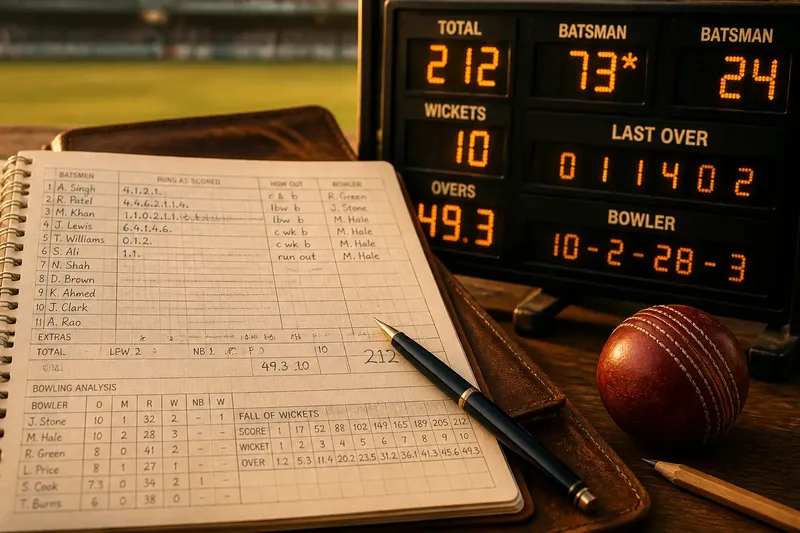
Score graphics often show the over as a sequence such as “3.4.” The number before the decimal point identifies completed overs; the number after it indicates legal balls bowled in the current over. “3.4” therefore means three overs and four legal balls, not three overs and four deliveries of any kind. A wide or no-ball may appear in the ball-by-ball display without advancing the second number.
Broadcasts may use abbreviations or symbols for extras, and their displays can vary. Watch for the umpire’s signal and the extras in the scorecard rather than relying only on the row of ball icons.
- If the legal-ball count stays unchanged after a delivery, check the umpire’s signal; if it was a wide or no-ball, expect the over to continue, otherwise compare the broadcast display with the scorecard.
- If the score rises while the legal-ball count does not, check whether an extra was recorded; if so, read the delivery as a wide or no-ball, otherwise wait for the score display to update.
- If the count reaches six after a delivery, check whether the umpire called it legal; if it was legal, expect the over to end, otherwise expect another delivery.
- If a bowler returns to the crease after what looked like the sixth ball, check for a wide or no-ball call; if one occurred, another legal ball is due, otherwise consult the official scorecard for the recorded count.
- If the notation and ball-by-ball icons appear to disagree, compare both with the extras column; if an extra explains the difference, follow the legal-ball notation, otherwise check the match’s official scoring display.
- If the free-hit indicator appears after a no-ball, check the competition’s playing conditions; if they provide for a free hit, expect that condition on the next delivery, otherwise follow the format-specific ruling.
What questions help explain the over count?
Does a wide count as one of the six balls?
No. A wide brings the applicable penalty and may allow further runs, but it does not count as a legal delivery. The bowler must still deliver the legal balls needed to finish the over.
Does every no-ball bring a free hit?
No. A free hit is provided in many limited-overs formats, but the competition’s playing conditions determine when it applies. Check those conditions if the free-hit rule affects how you interpret a dismissal or the next delivery.
Does an illegal bowling action automatically mean a no-ball?
No. A concern about an illegal bowling action is generally dealt with under the applicable regulations for the match, rather than treated as an ordinary no-ball call. The precise procedure depends on the governing rules and playing conditions.
What happens if a bowler delivers a wide after five legal balls?
The wide does not count toward the six, so one legal delivery is still required to complete the over. If that next delivery is also a wide or no-ball, the count still waits for a legal ball.
How does the six-ball count shape an innings?
Six legal deliveries give an over a compact rhythm. The fielding side has a defined sequence to complete before changing ends and bowler; the batting side can track progress through that sequence. The over also creates a small planning unit: a bowler may try to build pressure across several deliveries, while batters assess how to score and when to take a risk.
An illegal delivery interrupts that rhythm. It can give the batter another opportunity, and the bowler must deliver again before the over is complete. That extra ball may disrupt a plan built around a particular matchup or field setting, but the result depends on the next delivery and the match situation.
Imagine a bowler has delivered five legal balls and then bowls a wide. The starting count is five legal balls; the umpire signals wide, the batting side receives the applicable penalty, and the legal-ball count remains at five. The bowler then delivers a legal ball, bringing the total to six and ending the over. The observable result is an over notation that advances only after the legal delivery, even though the wide affected the score.
Keep the legal-ball count separate from the number of deliveries you see; that distinction explains most apparent interruptions.
Which view of an over is most useful?
Think of an over as a bowler’s turn if you are learning who bowls and when the ends change. This view makes the rotation easy to follow: one bowler completes six legal deliveries, then another takes the next over from the other end.
Think of it as six legal chances for the batting side if you are trying to understand why wides and no-balls extend it. Or treat it as a planning unit if you are watching tactics: batters and bowlers shape brief plans around the sequence, while an extra delivery can change those plans without changing the basic count.
For the central rule, remember that a cricket over ends after six legal deliveries, not merely after six balls have been bowled.
What should you check when the count seems unusual?
Start by checking for a wide or no-ball signal; either can explain why the count did not advance. Then compare the over notation with the delivery-by-delivery display, allowing for the fact that screens may represent extras differently. If the call or its effect matters to an official score or a disputed decision, consult the match’s governing playing conditions or a qualified umpire, since details can vary by competition.
Once you distinguish legal deliveries from all deliveries, the cricket over becomes a useful clock for live play: six valid balls mark the bowler’s turn, while an illegal delivery can affect the score or conditions without moving that clock forward.